The name
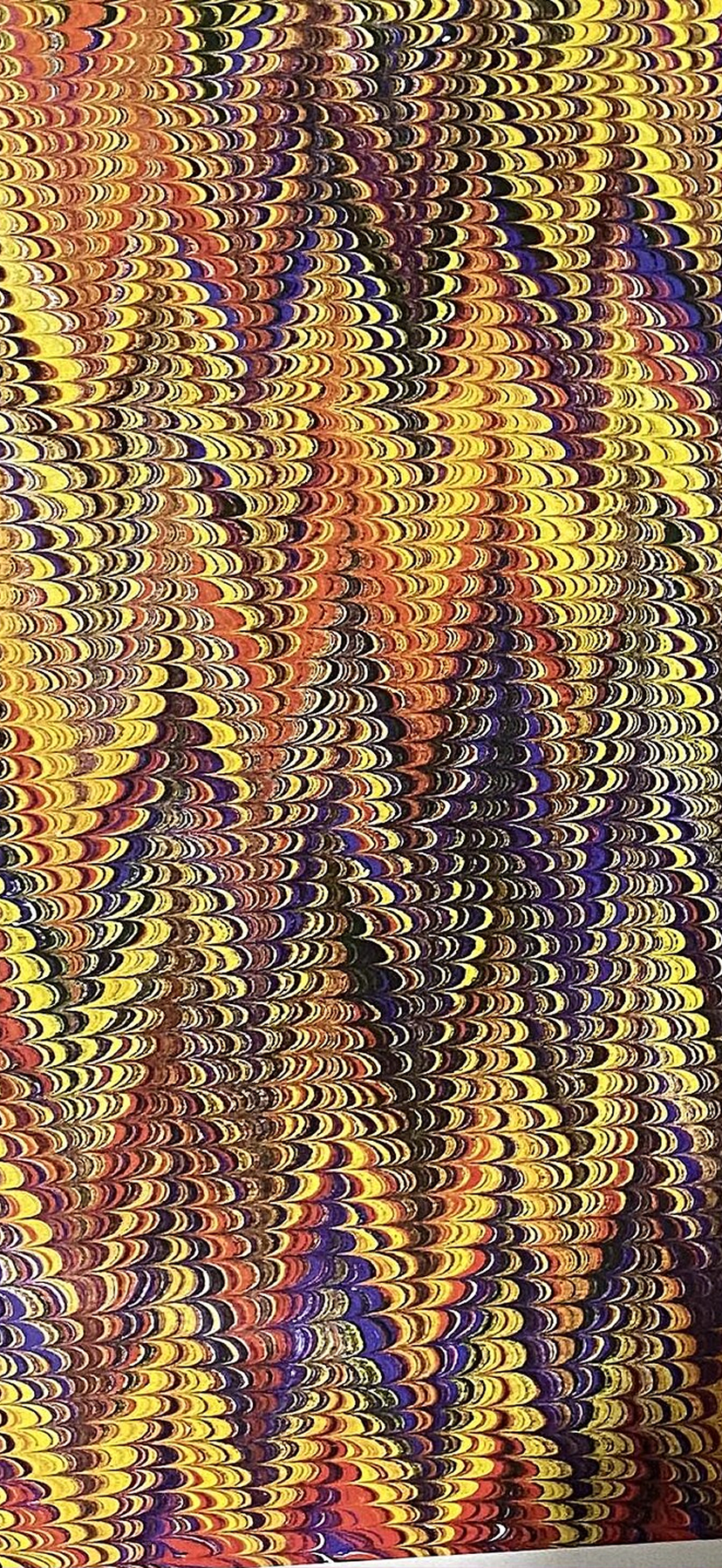
The word is usually traced to the Persian abr, cloud, through ebri or abri — cloud-like, clouded. A second reading points at the Chagatai ebre, meaning watered or moiré, which travelled west along the same route as the craft. Both readings describe the same thing: the veined, drifting surface of the finished sheet.
In Europe the technique arrived in the sixteenth century through Venice and Istanbul and was called Turkish paper — papier marbré in France, Turkish marbled paper in England.
What it was for
Ebru in the Ottoman world was a working material, not only a picture. Marbled sheets were used as mounts for calligraphy panels, as the borders and leaves of murakka albums, as endpapers and covers in bookbinding, and as the ground for cut-paper and gilt work.
It also had a bureaucratic job. Official documents and financial records were written on marbled paper precisely because the pattern cannot be reproduced: no two sheets are identical, and an erasure or an inserted line shows against the veining. A marbled ground is a security feature that happens to be beautiful.
Materials, in the tradition's own terms
- Kitre
- Gum tragacanth, the size. Soaked for a day or more, strained through cloth, and left to rest until it is clear and free of air. Its viscosity is the whole working surface.
- Toprak boya
- Earth pigments — lapis and indigo for çivit blue, ochres and red earths, lamp black, white from marble dust — ground on a stone slab with water until they are fine enough to float.
- Öd
- Ox gall, the surfactant, added to each colour in a rising sequence so the later drops can still open on the surface.
- Gül dalı fırçası
- A brush of horsehair bound to a rose branch. The wood is soft and slightly flexible, so the bundle springs rather than stabs, and the drops come off as a fine shower.
- Biz and tarak
- The needle and the comb. The needle draws single lines and resolves drops into figures and petals; the comb repeats a line at a fixed interval across the tray.
The masters who changed it
- Şebek Mehmed Efendi (d. 1620)
- The earliest ebru master named in the sources, from the Üsküdar circle; the oldest signed Turkish sheets belong to this period.
- Hatip Mehmed Efendi (d. 1773)
- Preacher at Hagia Sophia, and the inventor of the pattern that carries his name. Hatip ebrusu starts from concentric drops and draws them, with the needle alone, into symmetrical rosettes and stars — the first time ebru produced deliberate figures rather than veining.
- Necmeddin Okyay (1883–1976)
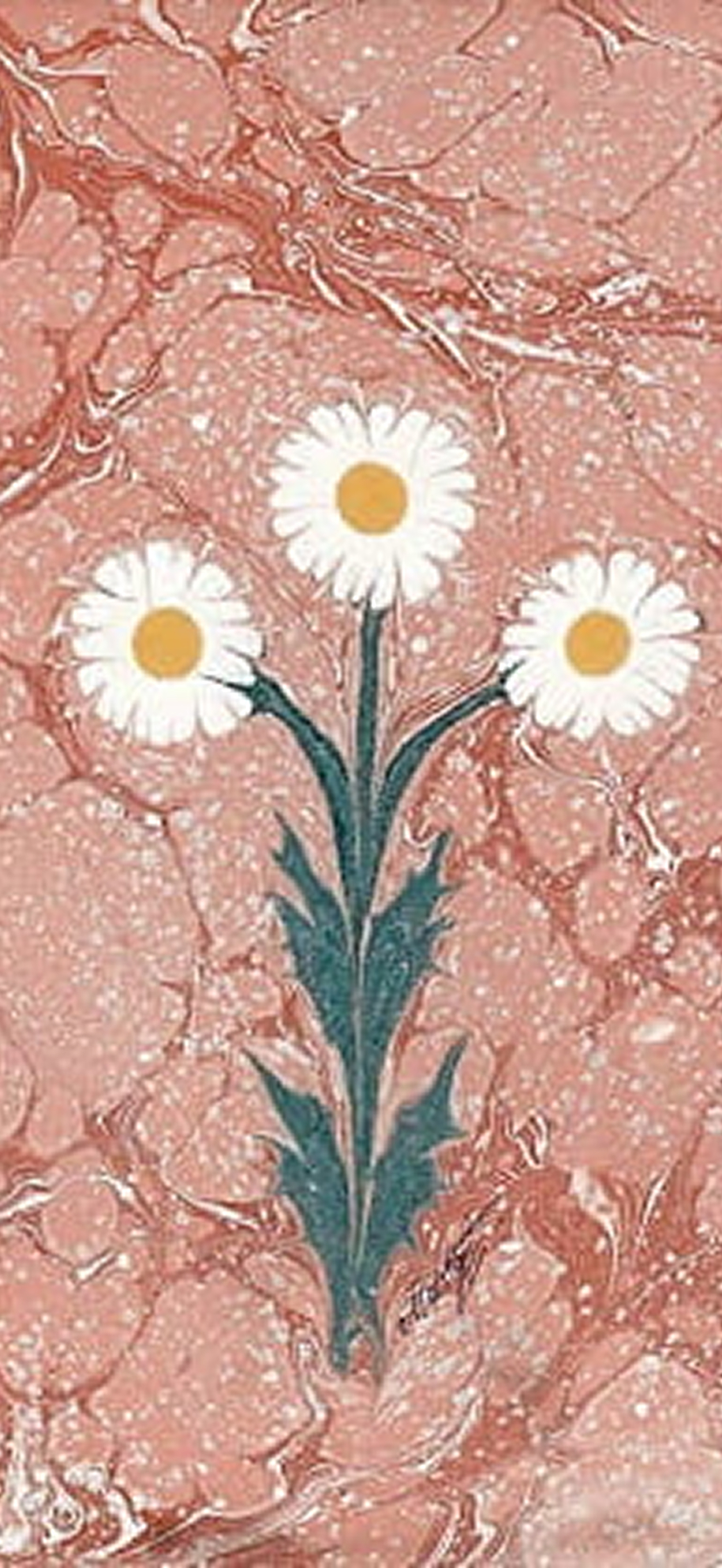
- The pivot of the modern tradition. Okyay worked out how to make recognisable flowers — tulip, carnation, hyacinth, daisy, poppy — on the surface of the water, and çiçekli ebru, floral marbling, is still known as Necmeddin ebrusu.
- Mustafa Düzgünman (1920–1990)
- Okyay's student, who codified the floral repertoire, added the daisy, and taught most of the generation that carried ebru into the present.
In 2014 UNESCO inscribed Ebru, Turkish art of marbling on the Representative List of the Intangible Cultural Heritage of Humanity, as a living practice transmitted master to apprentice.
The classical repertoire
- Battal — the ground pattern: drops only, no tool, each colour pushing the last into narrow borders.
- Gelgit — back-and-forth: the needle drawn across in alternating parallel passes.
- Şal — shawl: gelgit worked again in S-curves until it reads as woven cloth.
- Taraklı — combed: a comb pulled through gelgit for even, fine veining.
- Bülbül yuvası — nightingale's nest: the needle spiralled inward from the edge.
- Hatip — concentric drops drawn into rosettes, stars and hearts.
- Çiçekli — floral: tulips, carnations, hyacinths and daisies built petal by petal.
- Akkâse — a resist of gum arabic, so part of the sheet stays clear for calligraphy.
Each of these is a specific sequence of drops and tool passes, not a style. The pattern guide takes them one at a time.
Starting without a workshop
The barrier to ebru has never been talent; it is the tray. Kitre takes a day, alum-sized paper takes another, the size has a working life of weeks, and every session ends in cleanup. Ebru for iPad and iPhone keeps the physics and drops the logistics: a Metal fluid simulation with the traditional tool set — needles, combs, rakes, the rose-branch shower — plus layers and undo, which the water never offered.