Patterns come in families. The Turkish set builds from drops towards figures and finally towards flowers. The Western bookbinding set builds from the same drops towards ever finer mechanical veining. Suminagashi stays with the ring. All of them start in the same place.
The ground: drops only
- Battal (Turkish) · Stone (Western)
- Colours thrown onto the surface in fine drops, one after another, no tool at all. Each new colour pushes the earlier drops into a web of narrow borders. Every other pattern is this one, worked further.
- Kumlu, kılçıklı — sanded, serrated
- Battal made on size that has aged past its best. The drops break at the edge into grain or into a fish-bone fringe instead of opening cleanly. A fault turned into a pattern.
- Neftli — turpentine
- A trace of turpentine in the colour, so each drop dries with a pale veined core. Cloudy and translucent rather than flat.
- Antique spot
- The Western name for a stone ground thrown with a heavily galled final colour, so the last drops open very wide and leave large pale cells.
Drawn with needle and comb
- Gelgit — back-and-forth
- A single needle drawn across the battal in parallel passes, each the reverse of the last, at a regular interval. The borders stretch into vertical ribbons.
- Taraklı — combed · Nonpareil
- A comb pulled once through gelgit at right angles to it. The interval between the pins sets the whole character: a wide comb gives bold veining, a nonpareil comb with pins a millimetre apart gives the fine striped paper used on book edges.
- Şal — shawl
- Gelgit, combed, then worked again in S-curves across the tray. The surface reads as draped woven cloth. Three or four tool stages, which is close to the limit before the colours shear.
- Bülbül yuvası — nightingale's nest
- The needle spiralled inward from the edge of the tray towards the centre, pulling the whole pattern into a coil.
- Gloster, peacock, bouquet
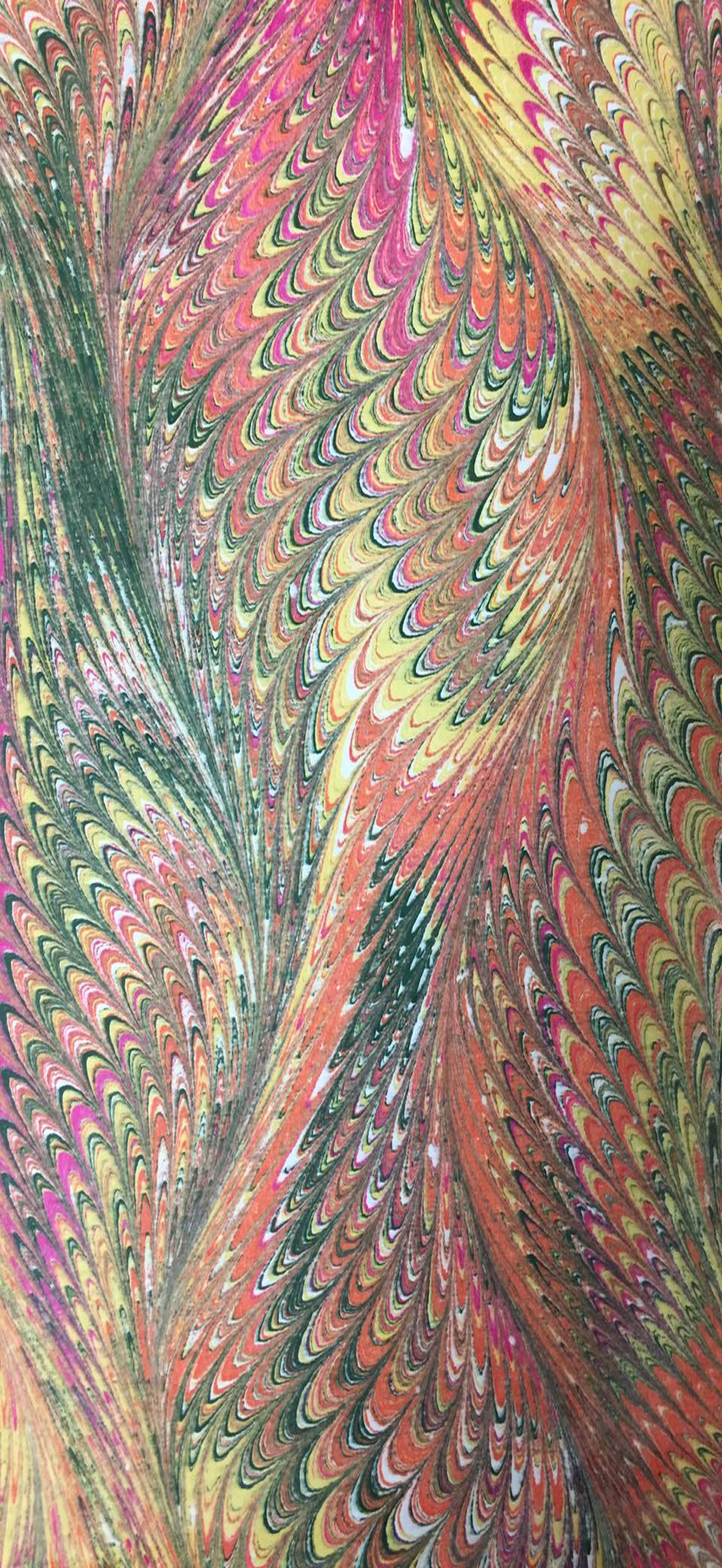
- The Western family: a nonpareil ground, then a wide comb drawn through it in one direction, so each stripe arches into a repeated fan. Peacock and bouquet differ only in comb spacing and in the direction of the final pass.
- French curl, snail
- A nonpareil ground worked with a stylus in a tight spiral at regular intervals, giving a grid of small coils.
- Spanish wave
- Not a tool pattern at all. The paper is laid in a rocking motion rather than flat, so it takes the colour in overlapping bands and the sheet appears ridged. The only pattern made during the pull.
- Stormont
- A stone ground with a final colour carrying a trace of turpentine, so it breaks into lace-like perforations.
Figures: the hatip family
Hatip Mehmed Efendi, preacher at Hagia Sophia and died 1773, found that concentric drops — one colour dropped into the centre of another, several times over — could be drawn with a needle alone into symmetrical figures. Pull four strokes outward from a stack of rings and you get a rosette; pull them in pairs and you get a heart; alternate the direction and you get a star.
Hatip ebrusu is the hinge in the tradition's history. Before it, ebru was pattern. After it, ebru could be an image.
Flowers: çiçekli ebru
Necmeddin Okyay worked out, in the early twentieth century, how to build recognisable flowers on the surface of the water. Each flower is a fixed order of drops and needle strokes: the stem drawn first, then the calyx, then the petals in a sequence that pushes the earlier ones into shape.
- Lale — tulip: three drops drawn up into points over a green stem. The flower most associated with the form.
- Karanfil — carnation: a wide drop whose edge is serrated with short needle strokes.
- Papatya — daisy: a yellow centre with a ring of white drops pulled outward. Added to the repertoire by Mustafa Düzgünman.
- Sümbül — hyacinth: a vertical stack of small drops, each pulled sideways.
- Gelincik — poppy: a dark heart in a broad red drop, drawn into four lobes.
- Hatmi — hollyhock: stacked drops along a long stem, worked from the bottom up.
Resist and ground effects
- Akkâse
- A resist. Gum arabic is painted onto the paper in the shape that must stay clear — usually a panel for calligraphy — and that area refuses the colour. The sheet comes out marbled around a blank field.
- Zerefşan
- Gold dust scattered over a finished sheet, a technique shared with Ottoman illumination rather than with marbling proper.
- Suminagashi rings
- The Japanese family, listed here for completeness: nested circles made by alternating ink and surfactant on plain water, then stretched by breath or by tilting the tray.
Working the repertoire on iPad
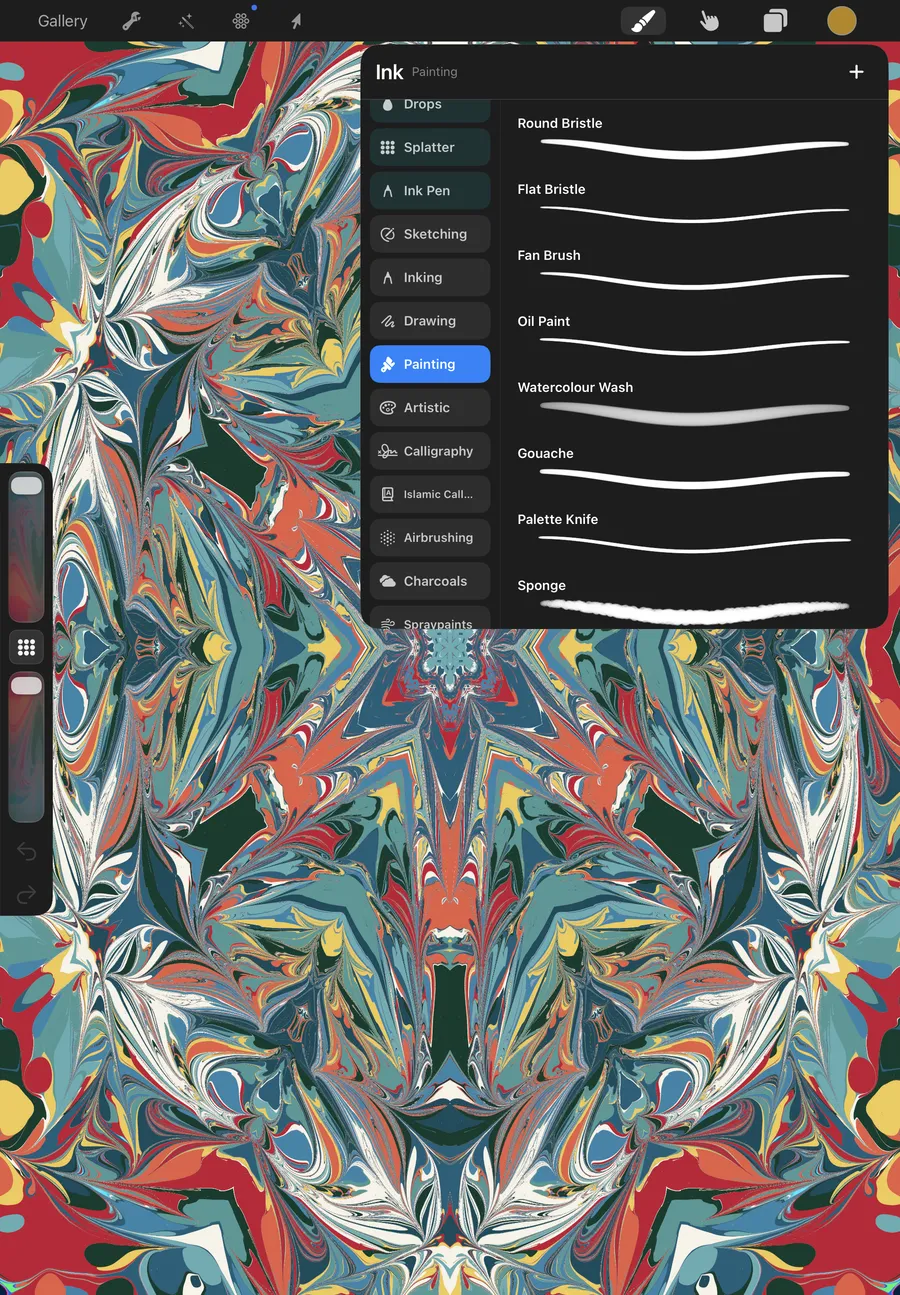
Ebru ships 61 shaping presets across nine families — styluses, combs, sweeps, waves, rings, figures, grains, flow and patterns — which is this vocabulary made into tools. The sequences are the same ones above; what changes is that an overworked tray costs an undo rather than a day.