The oldest of the three
Suminagashi is documented in Japan from the Heian period, around the twelfth century, which makes it the earliest marbling tradition with surviving work. Its first use was not decoration for its own sake: floated-ink papers were the ground for waka poetry, and the drifting rings were read as part of the poem's atmosphere rather than as a frame around it.
The practice was carried for generations by a small number of families — the Hiroba line in Echizen is the one usually named — as a transmitted craft with its own closely held recipes for the surfactant.
What makes a ring
On plain water, a drop of sumi would simply disperse. Suminagashi works by alternating two brushes. The first carries ink. The second carries the surfactant — traditionally pine resin or a soap-like additive, today often a photographic wetting agent. Touching the surfactant brush into the centre of a fresh ink spot pushes the ink outward into a thin circle instead of letting it diffuse.
Alternate ink, surfactant, ink, surfactant on the same point and you get nested rings, each one pushed out by the next. Because the water is not thickened, the whole set then drifts: the marbler moves it with breath, with a fan, or by tilting the tray, and the circles stretch into the long wavering bands that the tradition is known for.
- Fill a shallow tray with plain water Room temperature, still, and left to settle for a few minutes.
- Load two brushes One with sumi ink, one with the surfactant. Keep them separate; a contaminated ink brush stops making rings.
- Touch, alternate, repeat Ink to the surface, then surfactant to the same point, then ink again. Six or eight alternations give a readable set of rings.
- Move the pattern Breathe across the surface, fan it, or tip the tray. This is where the composition happens.
- Lay washi on top Centre first, then the edges. Washi takes the ink directly, so no alum is needed.
- Lift and dry flat One slow pull, then dry face up. The ink is already in the fibre.
Suminagashi next to ebru
- Surface
- Suminagashi floats on plain water; ebru needs a size of gum tragacanth. That single difference explains most of the rest.
- Tools
- Two brushes, breath and a fan, against the needle, comb and rake of the Turkish tray.
- Pigment
- Translucent ink that sinks into washi, against opaque earth pigments that sit on alum-mordanted paper.
- Form
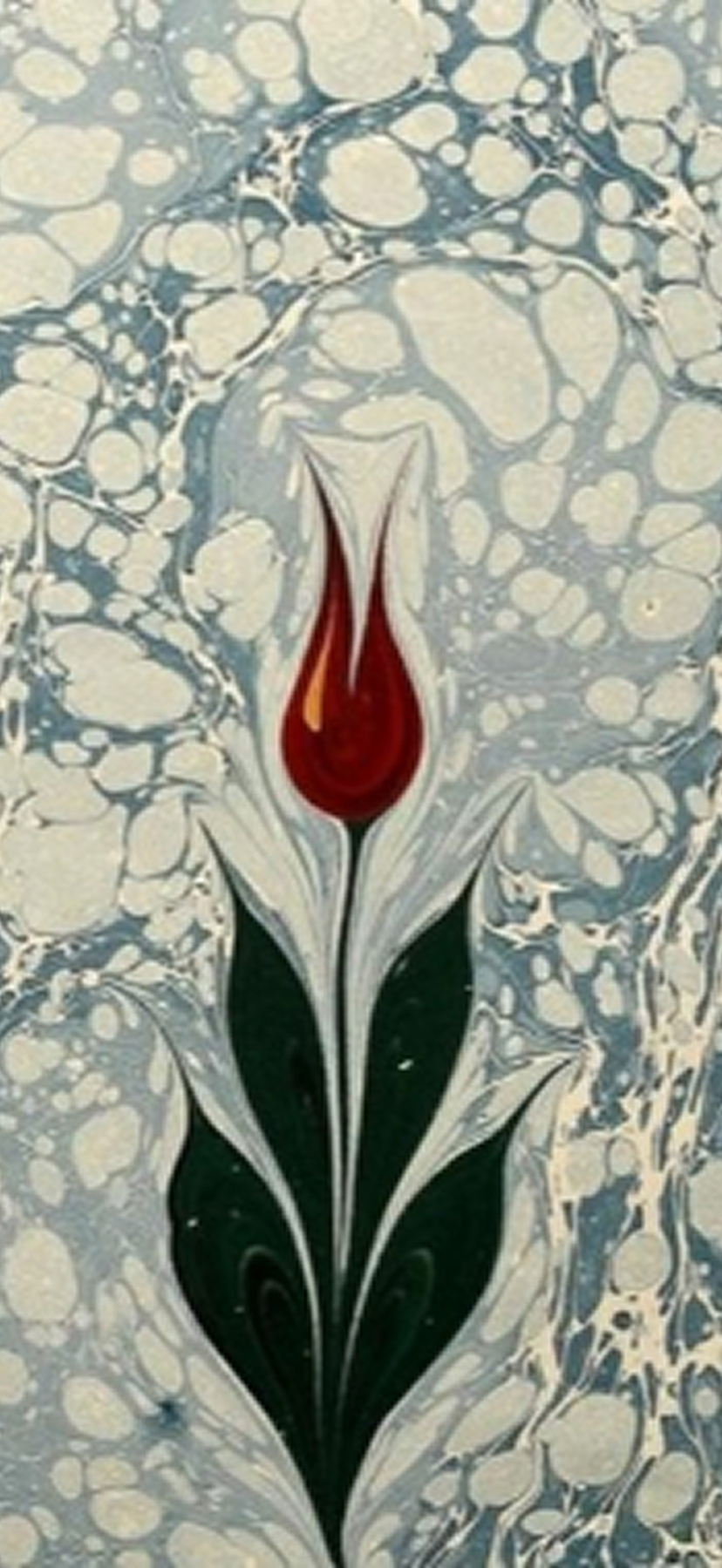
- Concentric rings stretched by drift, against veining, combed intervals and — in late ebru — deliberate flowers.
- Palette
- Usually black and its dilutions, sometimes indigo, against a full saturated range.
They are not rival techniques. A marbler who has learned to read an ink ring has learned the thing ebru also depends on: that the pattern is made by colours holding each other back, and that one touch too many destroys it.
Floating ink on a screen
Ebru for iPad simulates the same surface, so suminagashi is a tool choice rather than a different setup: a low-viscosity surface, a translucent ink, and a stylus that drops and spreads. The fan becomes a flow tool. What the water cannot give you — the ability to keep a ring you liked and try the next ten touches again — layers and undo do.