
One name, four techniques
There is no fixed definition of fluid art. The term grew up around acrylic pouring and is often used as a plain synonym for it. The other three are grouped with it because the result also comes from flow rather than from brush marks.
| Technique | Where the colour moves | What moves it | What you get |
|---|---|---|---|
| Acrylic pouring | On the canvas | Gravity and differences in paint density | Cells, lacing and soft blends on a rigid surface |
| Alcohol ink | On non-porous synthetic paper | Isopropyl alcohol, moving air, heat | Translucent blooms with hard, dark edges |
| Resin art | On a panel or in a mould | Gravity while the epoxy is liquid | A thick, glassy, permanent surface |
| Marbling | On a bath of thickened water | Surface tension, needles and combs | A flat print, lifted off by laying paper on the bath |
Acrylic pouring
Acrylic paint is thinned with a pouring medium until it flows, then poured onto a canvas and tilted. Common media are Floetrol (sold by Flood in the US and by Owatrol in Europe), Liquitex Pouring Medium and Golden GAC 800. Thinning with water alone weakens the binder, and the dry film can crack; a medium thins the paint without that loss.
- Dirty pour
- Several colours layered in one cup, then poured out together.
- Flip cup
- The layered cup is turned upside down onto the canvas and lifted, so the paint releases all at once.
- Puddle pour
- Colours poured one inside another in a single spot. Pouring in rings is the variation called tree ring.
- Swipe
- A thin layer of paint is dragged across the poured colours, which pulls up the layer beneath and opens cells.
Cells, the round openings that pouring is known for, come from paints of different densities passing through each other. Many pourers add a few drops of silicone oil to encourage them, and pass a torch over the surface to pop bubbles and bring cells up. Silicone can make a later varnish harder to bond, so it is worth cleaning the dry surface first.
The technique is older than its online popularity. In 1936 the Mexican painter David Alfaro Siqueiros ran an experimental workshop in New York where poured layers of paint were left to flow into each other; physicists have since described those patterns as a Rayleigh–Taylor instability, where a denser liquid sinks into a lighter one.
See also: Acrylic pouring
Alcohol ink
Alcohol inks are dye inks in an alcohol base. They are worked on a non-porous surface, most often Yupo, a synthetic polypropylene paper, because on ordinary paper they soak in and stop moving. Isopropyl alcohol or a blending solution reopens the ink; air from a blower or a straw pushes it; a heat tool dries it fast but can warp Yupo.
Resin art
Epoxy resin is mixed with its hardener, tinted, and poured onto a panel or into a mould, where it flows until it cures. The finish is glassy and permanent. Resin is a chemical process, not a paint: wear nitrile gloves rather than latex, work with good ventilation, and use a respirator if the room is poorly ventilated or when sanding cured resin. Skin sensitisation is the main risk, and it builds up with repeated contact.
Marbling
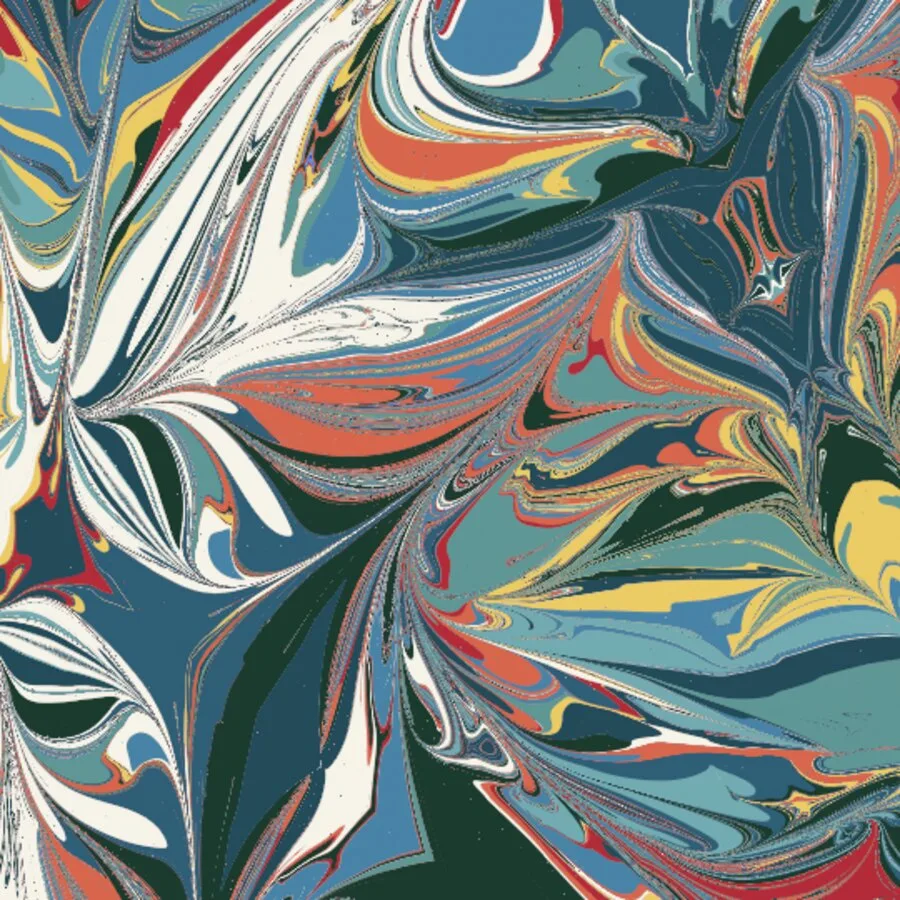
Marbling is the odd one out. The colour never touches the final surface until the very end: it floats on water thickened with carrageenan, methylcellulose or gum tragacanth, is shaped there with needles and combs, and is then lifted off in one pass by laying alum-treated paper on top. Each sheet is a monoprint, and the bath is changed by every pull.
That makes marbling the most controllable of the four. A pour is steered by tilting; a marbled pattern is drawn, stroke by stroke, and the classical patterns are named sequences of those strokes.
See also: Paper marblingHow to marble paperAcrylic marbling
Which one to start with
- For a finished piece on canvas with little setup, start with acrylic pouring.
- For quick, bright, small studies, start with alcohol ink on Yupo.
- For a hard, glossy object such as a tray or a coaster, use resin, with the safety gear above.
- For patterns you design on purpose, and for paper you can use in bookbinding or cards, learn marbling.
Fluid art on iPad
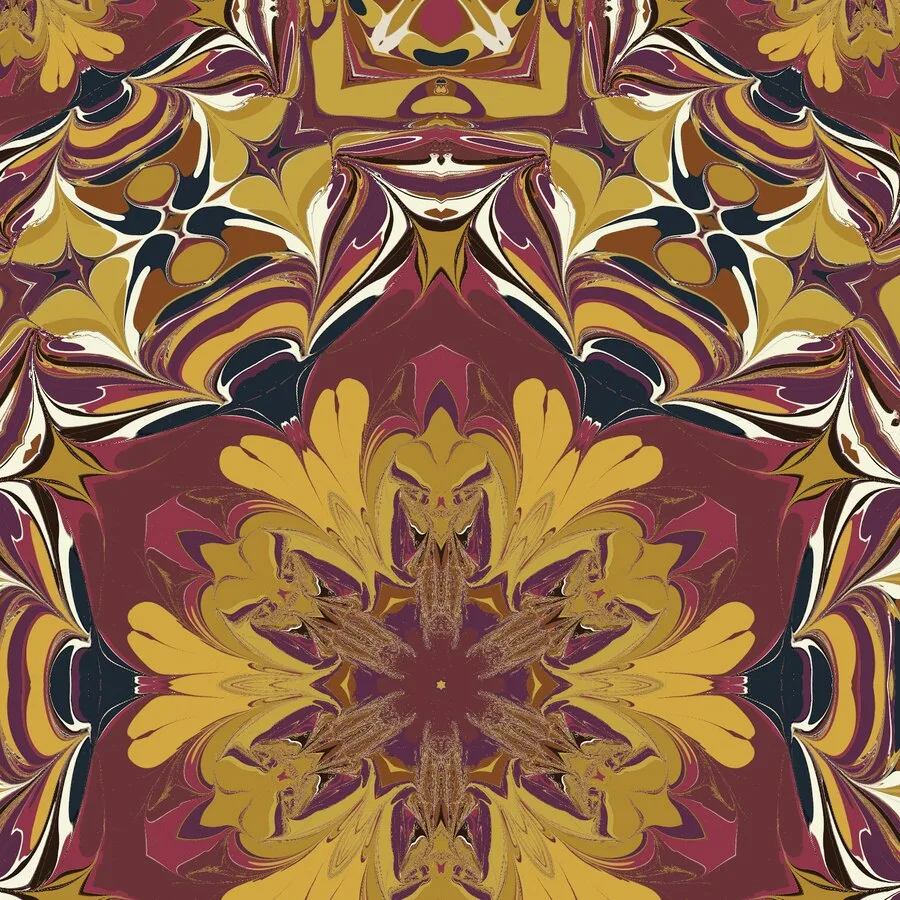
Digital fluid art comes in two kinds. Smudge and liquify brushes push pixels around and only look fluid. Simulation apps compute how the colour should move. Ebru is a simulation of the marbling bath: every new drop pushes the colours already floating, and every comb drags the whole pattern with it. It does not simulate pouring, cells or resin; it simulates ink on water, which is the one form of fluid art where you shape the flow by hand.
What the screen adds is what water cannot give: undo, layers and groups, mirror, rotation, tiling and spiral symmetry, Apple Pencil pressure and tilt, palettes taken from a photo, and PNG or JPEG export at up to 4K. Ebru is free to download; Ebru Pro, a single in-app purchase, unlocks the full set of shaping tools.