
Materials
- Size
- The thickened liquid in the tray that holds colour on its surface. Called kitre water in Turkish practice and simply the bath in some English sources.
- Carrageenan
- A thickener extracted from red seaweed, and the Western standard for size. Only the lambda type is used, because kappa and iota gel as they cool.
- Methylcellulose
- A modified cellulose thickener. Cheap, long-lasting and tolerant of hard water; the usual choice for classrooms.
- Kitre (gum tragacanth)
- Sap of the Astragalus shrub, soaked and strained; the traditional ebru size.
- Alum
- Potassium aluminium sulphate, the mordant applied to paper or fabric so pigment bonds to the fibre instead of washing off.
- Mordant
- Any substance that fixes a colourant to a fibre. In marbling it means alum, in practice always.
- Ox gall (öd)
- Filtered cattle bile, used as a surfactant. Added to a colour it lowers that colour's surface tension so the drop spreads and pushes its neighbours back.
- Dispersant
- The general term for anything doing ox gall's job, including synthetic marbling dispersants.
- Toprak boya
- Earth pigment, ground on a stone slab with water. The traditional ebru colourant: lapis and indigo for blue, ochres and red earths, lamp black, marble dust for white.
- Sumi
- Japanese ink made from soot and animal glue, the colourant of suminagashi. It floats on plain water and needs no thickened size.
- Washi
- Japanese paper made from long plant fibres. Absorbent enough that sumi ink bonds without a mordant.
Tools
- Tray (tekne)
- The shallow vessel holding the size. Slightly larger than the paper, and flat enough to give a level surface.
- Biz
- The Turkish needle or awl, used to draw single lines and to resolve drops into figures and petals.
- Stylus
- The English equivalent of the biz: any smooth point used to draw through the floating film.
- Tarak (comb)
- A batten carrying evenly spaced pins or tines, drawn across the tray to repeat a single line at a fixed interval.
- Rake
- A comb with wide spacing, used for broad veining rather than fine stripes.
- Gül dalı fırçası
- The ebru brush: horsehair bound to a thin stick, by many accounts a rose branch. Tapped against the hand, it throws a fine shower of drops.
- Skimming strip
- A strip of newspaper laid flat on the size and lifted off to remove the surface skin and any dust. Used before every sheet.
See also: Marbling supplies
Processes
- Throwing
- Flicking or tapping colour off a brush so it lands as a shower of fine drops rather than as blobs.
- The pull
- Laying the paper on the surface and lifting it off. The whole pattern transfers in this one movement.
- Mordanting
- Wiping or soaking alum into paper or fabric and drying it before marbling.
- Skimming
- Removing the skin that forms on the size within minutes of it standing still.
- Shearing
- What a tool does to the floating film: it displaces colour along the path and drags the borders between colours into cusps.
- Overworking
- Making too many tool passes. Each pass shears the film further; around eight the borders collapse and the tray greys out.
- Ghost sheet
- A second sheet pulled from the same tray without re-throwing colour. Pale, and sometimes deliberately so.
Turkish pattern names
- Battal
- The stone ground: colours thrown in fine drops and left untouched by any tool. Every other pattern begins here.
- Gelgit
- Literally tide. A single stylus pulled in parallel passes, each reversing direction, so the borders stretch into vertical bands.
- Taraklı
- Combed. A comb drawn at right angles over a gelgit, which repeats the line at a fixed interval and gives fine veining.
- Şal
- Shawl. Made on a gelgit ground, which the needle then works in S- or Z-shaped curls. The surface reads like patterned cloth.
- Bülbül yuvası
- Nightingale's nest. Small spirals drawn with the stylus at set points across the ground, each turning between the edge of its circle and its centre.
- Hatip ebrusu
- Concentric drops on a light ground, drawn with a fine needle into motifs such as the pinwheel, the heart and the star. Named after Hatip Mehmed Efendi, who died in 1773.
- Çiçekli ebru
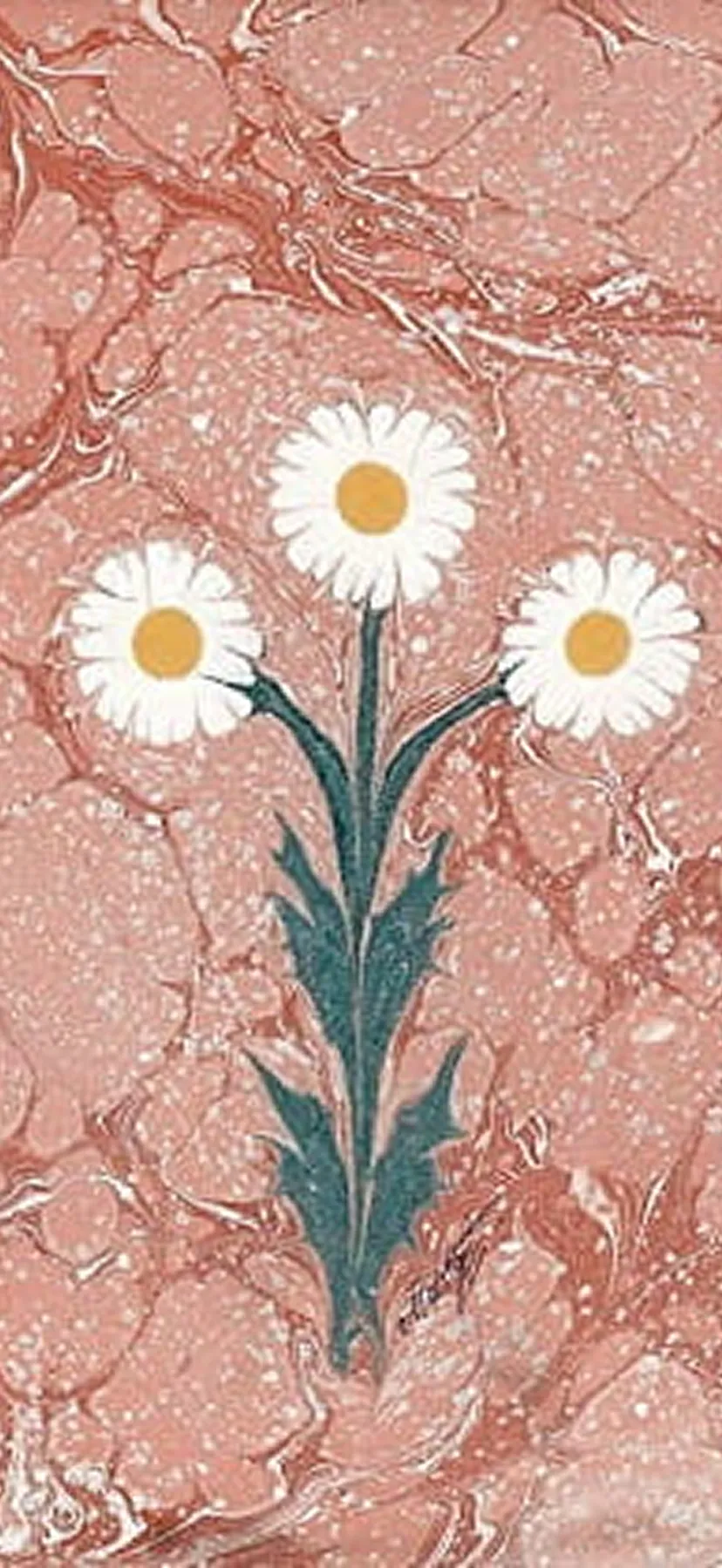
- Floral marbling: recognisable flowers built drop by drop and drawn with the stylus. Also called Necmeddin ebrusu after Necmeddin Okyay, who developed it in the early twentieth century.
- Akkâse
- Part of the sheet, usually a field for calligraphy, is kept free of marbling: originally with a gum arabic resist, today mostly with a cut-paper stencil.
- Neftli ebru
- Ebru with a little naphtha (neft) added to one colour, usually the last, which opens small holes and halos in it.
Western pattern names
- Stone
- The English name for battal: the untooled thrown ground.
- Nonpareil
- A fine striped pattern made by combing with tines about one to three millimetres apart. The classic book-edge and endpaper pattern.
- Gloster
- A dispersant such as turpentine added to one colour, usually over a combed ground, so it opens into round spots. Often confused with Stormont.
- Peacock
- A combed ground finished with a widely spaced comb that leaves loops like the eyes of a peacock feather.
- Bouquet
- Wavy passes drawn over a nonpareil ground. Often used interchangeably with peacock.
- French curl
- Swirls drawn with a stylus or a single-tooth comb at regular intervals into a finished ground, giving a grid of small coils. Also called snail.
- Spanish wave
- Not a tool pattern. The paper is rocked as it is laid down, so it meets the surface in overlapping bands and the sheet looks embossed.
- Stormont
- A pattern in which turpentine in a colour opens it into a lacy network of tiny holes.
- Endpapers
- The sheets pasted inside the front and back covers of a book. Historically the largest single use for marbled paper.
See also: Marbling patterns
Traditions and people
- Ebru
- The Turkish tradition of marbling. The name is usually traced to the Persian abr, cloud, through ebri — cloud-like. Inscribed on the UNESCO Representative List of the Intangible Cultural Heritage of Humanity in 2014.
- Suminagashi
- Japanese ink floating. Its earliest surviving examples, from the early twelfth century, are the oldest known marbled paper. Sumi ink on plain water, shaped by breath and slow currents into concentric rings.
- Turkish paper
- What marbled paper was long called in Europe, after the Istanbul route by which it arrived from the late sixteenth century.
- Hatip Mehmed Efendi
- Preacher at Hagia Sophia, died 1773. Found that concentric drops could be drawn into symmetrical figures, which turned ebru from pattern into image.
- Necmeddin Okyay
- Developed floral ebru in the early twentieth century, building recognisable flowers on the surface of the size. Floral marbling is still called Necmeddin ebrusu.
- Mustafa Düzgünman
- Okyay's nephew and student, who added the daisy to the floral repertoire.
- Marbling
- The English name for the whole family of techniques, from the resemblance of the veined patterns to polished marble.