

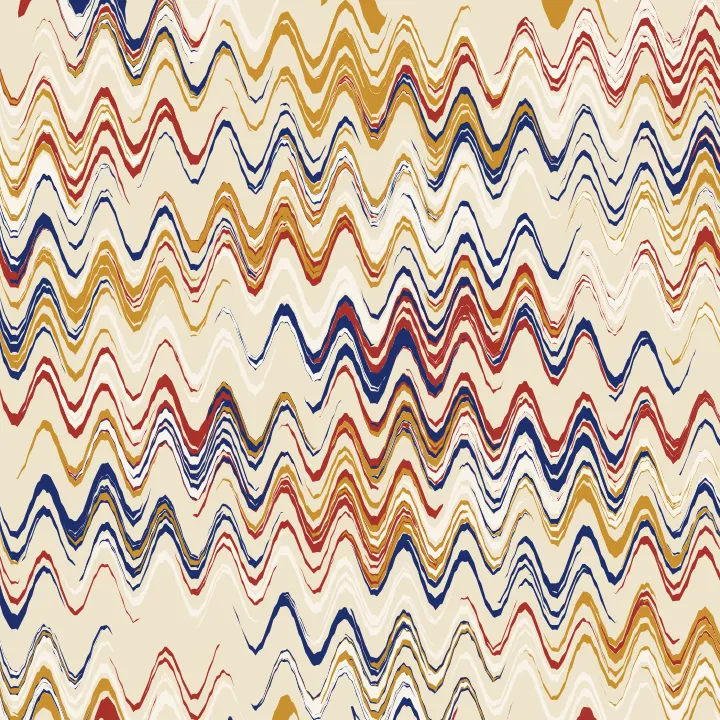
Bouquet or peacock?
Sources do not agree on where one name ends and the other begins. MarbleArt treats them as one pattern and calls it Peacock (Bouquet). Other descriptions, including the pattern field guide on this site, keep peacock for the version whose last pass leaves large loops like the eyes of a feather, and bouquet for wavy passes over a nonpareil. Either way the sequence is the same, and what changes the look is the spacing of the comb and the rake.
Tools
- Stylus or rake for the gel-git
- A chopstick-thick stick, or a rake with pins about 5 cm (2 inches) apart.
- Nonpareil comb
- Teeth about 5 mm apart (five per inch). For a peacock with fine detail, many marblers use a fine comb instead.
- Double rake (bouquet comb)
- Two staggered rows of nails or pins. MarbleArt's has nails set in triangles about 3.8 cm (1½ inches) apart. The same tool is used for frog-foot and thistle patterns.
How to make the bouquet pattern
- Leave room in the tray Allow a margin of about 2.5 cm (an inch) of free surface around where the paper will go, so the rake has room to turn.
- Make an even nonpareil Stone ground, gel-git across, then one straight pass of the comb. The tighter and more even this stage, the better the bouquet.
- Draw the double rake from the top Set the rake in at the top edge and draw it down the tray, moving it from side to side in a small, even wave as it travels.
- Keep the wave regular Same width of swing, same speed, all the way down. An irregular wave gives shapes of different sizes across the sheet.
- Print at once Lay the paper while the lines are sharp, lift in one pull, rinse and dry flat.
What changes the look
| Change | Effect |
|---|---|
| Finer nonpareil comb | More, thinner lines inside each shape |
| Wider rake spacing | Larger shapes, closer to the peacock eye |
| Bigger side-to-side swing | Deeper, rounder curves |
| A final straight pass with a wide rake | Ties the shapes into horizontal rows |
When it goes wrong
| What you see | Likely cause | What to change |
|---|---|---|
| Shapes blurred, stripes lost | Nonpareil too loose or uneven | Comb more evenly; check the gel-git spacing |
| Pointed spikes | Raked from the wrong end | Start the rake at the top edge |
| Shapes vary across the sheet | Uneven wave | Slow down and keep the swing the same width |
| Muddy colours | Too many tool passes on a tired size | Fresh surface, fewer colours |
Bouquet takes four tool passes, which is a lot of practice material. The free marbling simulator on this site lets you rehearse the ground and the comb; the Ebru app on iPhone and iPad has comb, rake and wave presets, and an undo when a pass goes wrong.
See also: Nonpareil patternGelgit patternMarbling patternsTroubleshooting