
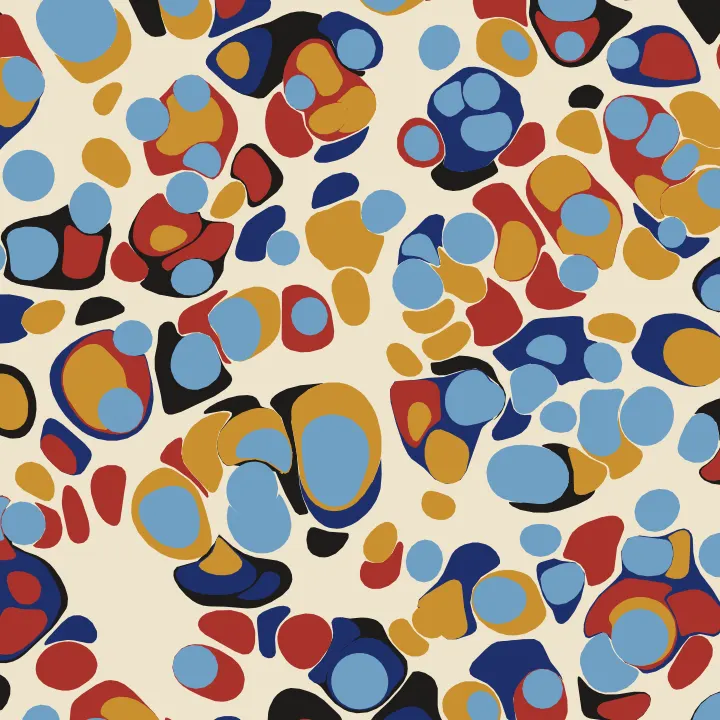
The stone pattern takes longer than it looks. A combed pattern is a few passes of a tool; a stone sheet is built from thousands of small drops, and its character comes from the order of the colours and how much gall each one carries. Get those two right and the pattern almost makes itself.
What you need
- A tray of rested size: carrageenan or methylcellulose for Western marbling, gum tragacanth (kitre) for Turkish ebru.
- Four to six colours. Black is a common first colour, and most stone papers use five or six.
- Ox gall or another dispersant, added to each colour in its own jar.
- One brush per colour. The Turkish brush is horsehair bound to a thin stick; a stiff paintbrush or a whisk broom works for practice.
- Paper treated with alum, if your colours need it, and a strip of newsprint to skim the surface clean.
How to make the stone pattern
- Skim the size Draw a strip of newsprint across the surface to lift dust and skin. Drops land unevenly on a dirty surface.
- Test every colour Sprinkle a few drops of each colour on a corner of the tray. A drop that sinks or stays small needs another drop of gall in its jar; a drop that races outward and goes pale needs more paint.
- Throw the first colour Load the brush and tap its stick against your other hand or a rod, so the colour falls as a fine shower. Cover the whole tray evenly. This colour carries the least gall.
- Throw the next colours in order Each later colour gets a little more gall than the one before, so it can push the earlier drops aside. Work through the jars in the order you planned.
- Stop before the surface is crowded When the earlier colours have become narrow borders, the pattern is done. More colour after that only makes the veins harder to see.
- Lay the paper and lift Lower the sheet from one corner so no air is trapped, wait a moment, then lift it in one pull, rinse off the size and dry it flat.
What controls the size of the stones
- Gall
- More gall makes a colour spread wider. The last colour, carrying the most, opens into the largest stones and pushes everything before it into thin lines.
- Drop size
- A brush tapped hard throws fine spray and small stones. A brush loaded heavily and tapped gently throws large drops.
- Order
- The first colour ends up as the finest veining, the last as the largest areas. A dark first colour gives the classic look of pale stones outlined in black.
- Shades of one colour
- Throw a colour, add a drop of gall to its jar, and throw it again. The second layer spreads wider and looks paler, so one jar can give two or three tones of the same colour.
Variations of the stone pattern
- Kumlu (sanded)
- One colour is broken into fine grain instead of opening as a clean drop. Ottoman sheets of this kind are common enough to be sorted as their own class.
- Neftli
- A little naphtha in one colour, usually the last, makes it open with small holes and halos. Turpentine and light oils are used the same way today.
- Stormont and gloster
- Western names for stone grounds where turpentine in one colour opens a lacy net of holes (Stormont) or round spots (gloster).
- Every combed pattern
- Gelgit, nonpareil, bouquet and şal all start as a stone ground. The tool work comes after.
When the stone pattern goes wrong
| What you see | Likely cause | What to change |
|---|---|---|
| Drops sink or stay as dots | Too little gall, or paint too thick | Add a drop of gall, or thin the paint |
| A new colour will not push the old ones | Same amount of gall in both | Add a drop more gall to the later colour |
| Every colour pale and spread thin | Too much gall | Add more paint to the jar |
| Stones uneven, bare patches | Brush tapped too close, or surface dirty | Skim the size, tap from higher up |
You can try colour orders without mixing a tray: in the free marbling simulator on this site, press Battal for a full stone ground or tap drops in yourself, and each new drop pushes the older ones the same way size does. The Ebru app on iPhone and iPad adds the combs, needles and figure tools for what comes after.
See also: Gelgit patternOx gallMarbling paintMarbling patterns