
The tool
One pointed stick, thinner than a pencil and thicker than a toothpick: about 5 mm (3/16 inch) across. A wooden chopstick is close to the right size. Turkish marblers use a needle or a metal awl on gum tragacanth. A rake with pins set about 5 cm (2 inches) apart makes the same pattern in fewer passes on a wide tray.
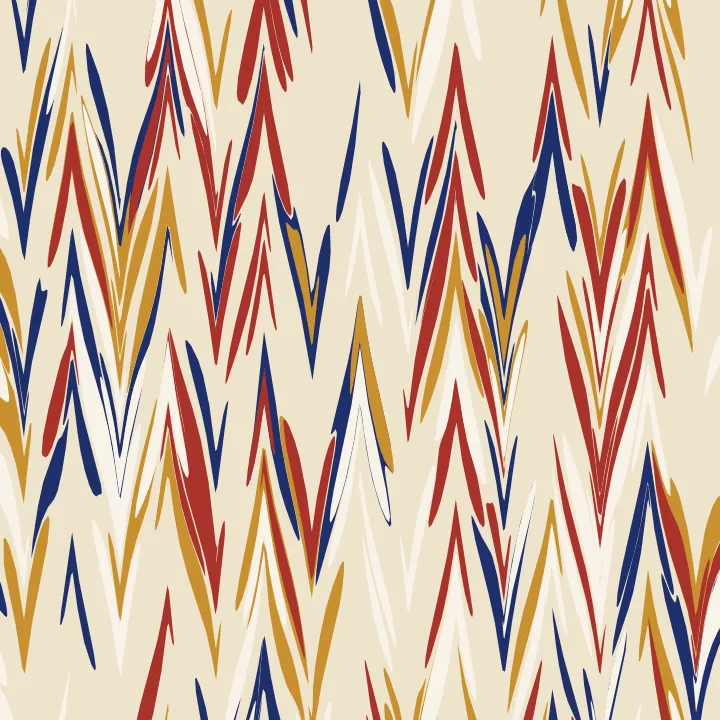
How to make the gelgit pattern
- Throw a stone ground Three or four colours thrown as drops, the first with the least gall. Leave a little of the surface bare so the ribbons stay distinct.
- Start at the top edge Hold the stick at about 45 degrees with its tip in the size, and draw it across the tray from one side to the other.
- Come back the other way Lift at the edge, move down about 1.3 cm (half an inch), and draw the next line in the opposite direction.
- Keep the spacing even down the whole tray Even spacing gives even ribbons. Uneven spacing is the most common reason a later comb pattern looks patchy.
- Print or keep going Lay paper now for a plain gelgit, or comb across the lines for nonpareil and the patterns built on it.
Spacing changes the pattern
| Line spacing | Result |
|---|---|
| Wide, 3 to 5 cm | Broad, slow waves; the stones still read as stones |
| About 1.3 cm | The classic gelgit: even ribbons that go well under a comb |
| Very close | Thin, crowded ribbons; the colours start to blur together |
Patterns built on gelgit
- Taraklı (combed) and nonpareil
- A comb drawn across the gelgit lines. Close-set teeth give nonpareil.
- Şal (shawl)
- The needle is worked across a gelgit in S- or Z-shaped curls, and the stretched colours fold into something like patterned cloth.
- Bülbül yuvası (nightingale's nest)
- Small spirals drawn at set points across a gelgit, filling the sheet with coils.
- Bouquet and peacock
- A wave pass with a wide rake over a nonpareil, which itself started as gelgit.
To see the pattern before you mix a size, open the free marbling simulator on this site, press Battal, then press Gelgit, or drag the needle back and forth yourself. The Ebru app on iPhone and iPad has comb and rake tools for the patterns that follow.
See also: Stone patternNonpareil patternBouquet patternMarbling patterns