
What you need
- A tray of rested carrageenan or methylcellulose size, a little longer than the comb is wide.
- Three to five colours with gall, tested on the surface first.
- A stylus or chopstick for the gel-git, or a rake with pins about 5 cm (2 inches) apart.
- A comb as wide as the tray. The standard nonpareil comb has about five teeth per inch, roughly 5 mm apart.
- Paper treated with alum, if your colours need it.
How to make nonpareil
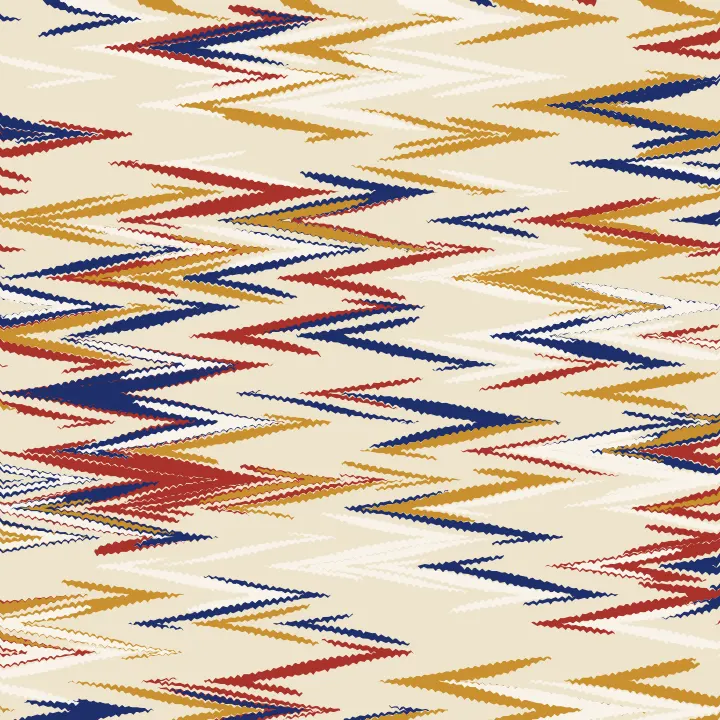
- Throw a stone ground Cover the tray with drops, colour by colour, each later colour with a touch more gall. Keep it fairly even; gaps show as breaks in the stripes.
- Draw a gel-git With the stylus at about 45 degrees, draw lines across the tray side to side, each about 1.3 cm (half an inch) below the last and in the opposite direction.
- Set the comb in at the top Lower the comb into the size at one end so every tooth is in the liquid, square to the tray.
- Pull it straight to the other end One steady pass, at an even speed, without stopping or wobbling. Lift it out at the far end.
- Print Lay the paper from one corner, wait a moment, lift in one pull, rinse and dry flat.
Choosing the comb
| Comb | Teeth | Result |
|---|---|---|
| Wide | About 4 per inch | Bolder stripes, quicker to read from a distance |
| Standard | About 5 per inch, 5 mm apart | The traditional nonpareil |
| Fine | About 10 per inch | Very fine stripes, closer to a fabric texture |
You can make a comb from a strip of wood or foam board and pins pushed through at a fixed interval. Mark the interval with a ruler first: uneven teeth give uneven stripes, and the eye notices.
Common faults
| What you see | Likely cause | What to change |
|---|---|---|
| Patches and blotches | No gel-git, or uneven gel-git | Draw the back-and-forth lines evenly first |
| Stripes wobble or kink | The comb stopped or tilted mid-pass | One steady pull, comb square to the tray |
| Stripes muddy | Too many colours, or the size is too thin | Use three to five colours; check the size |
| Breaks across the stripes | Gaps in the stone ground | Throw the ground more evenly |
Patterns that start as nonpareil
Nonpareil is also the middle step of several other patterns. Bouquet and peacock add a wave pass with a wide double rake. Feather patterns add a further pass with a comb. Each one only works if the nonpareil under it was even.
In the free marbling simulator on this site, Taraklı pulls a comb across a gelgit ground, the same sequence at a coarser spacing. The Ebru app on iPhone and iPad has comb and rake presets for the finer versions.
See also: Gelgit patternBouquet patternStone patternMarbling patterns