

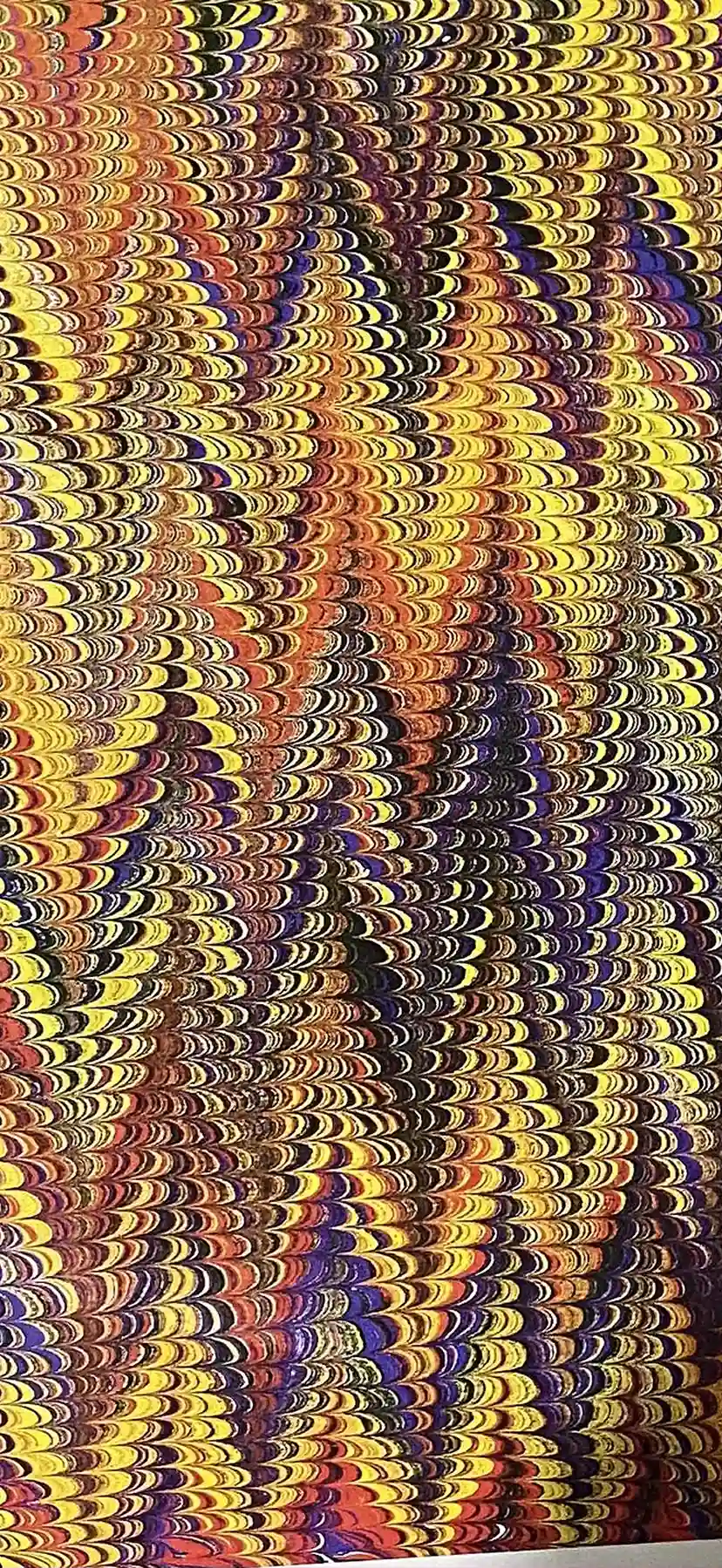
What ox gall does
Paint dropped on a size has two choices: spread across the surface, or fall through it. Ox gall is a surfactant. It lowers the surface tension of the colour so the drop opens outward, and it lets a later colour push the earlier ones aside instead of mixing into them. Talas, a conservation supplier, describes the effect as colours spreading out in large flat rings. Colophon Book Arts calls it the first thing to reach for when colours sink.
Gall does not bind the colour to the paper. That is the job of alum on Western papers. Gall only decides how a drop behaves on the surface.
How to dose ox gall
- Work from a small jar of each colour Pour a little colour, about a centimetre deep, into its own jar. Small amounts are easier to correct than a full pot.
- Add gall to the colour, never to the tray One or two drops, stirred in. A neat drop of gall on the size opens a hole that nothing will close, and the surface has to be skimmed and rebuilt.
- Test on the size Sprinkle a few drops on a corner of the tray before every session. Size, temperature and paint change from day to day, so yesterday's dose is only a starting point.
- Correct one drop at a time Sinks or opens small: add a drop of gall. Races outward and goes pale: add more colour to the jar.
- Give each later colour a little more The first colour on the tray needs the least gall. Every later colour needs slightly more, so it can push the colours already there.
| What the test drop does | Meaning | Fix |
|---|---|---|
| Sinks, or leaves a cloud under the surface | Too little gall, or paint too thick | One more drop of gall, or thin the paint |
| Sits as a small dot | Too little gall | One more drop of gall |
| Opens to a clean, coloured ring | About right | Leave it |
| Races to the edges and goes pale | Too much gall | Add more colour to the jar |
| Will not push the colour before it | Same dose as the earlier colour | One more drop than the earlier colour |
Ox gall and acrylic paint
Sources disagree here. MarbleArt says genuine ox gall is not strong enough to work with acrylic colours, and its own gall is a synthetic detergent. The teacher Barb Skoog writes that she replaced ox gall with Golden's Acrylic Flow Release, now sold as a wetting agent. Suppliers such as Talas and Colophon sell ox gall for marbling without that caveat. In practice, if acrylic still sinks after a few drops of ox gall, switch to a synthetic dispersant or a wetting agent made for acrylics.
Alternatives to ox gall
- Synthetic ox gall
- Sold by several art brands as a replacement. No animal product, no smell, and often the better choice for acrylics.
- Acrylic flow release or wetting agent
- Made to lower the surface tension of acrylic paint. Dose it the same way: a drop at a time, tested on the size.
- Photographic wetting agent
- A modern stand-in used by some marblers and in suminagashi.
- Washing-up liquid
- Works weakly. It foams and keeps spreading after the drop lands, so patterns soften.
Buying and storing
- Marbling ox gall is sold prepared, often preserved in alcohol. Colophon ages theirs at least nine months.
- Keep the bottle closed and cool. Use a dropper, not a brush, so the dose stays countable.
- Ox gall is an animal product. If that matters to you, choose a synthetic one.
- Gall is not needed for every method: shaving cream, nail polish and hydro dipping work without it.
Drop behaviour is easy to see on screen before you spend paint: in the free marbling simulator on this site every new drop pushes the older ones the way a well-dosed colour does. The Ebru app on iPhone and iPad models the same push with its full set of tools.
See also: Marbling paintMarbling sizeTroubleshootingStone pattern